
Tierra del Fuego, Summer 2015
“King Penguins?” I asked for the third time.
My Spanish is very limited, but I was pretty sure I understood the travel agent.
“Sí, sí,” her red pen circled an area on the colourful tourist brochure. “The Colony lives here.”
Her English was much better than my Spanish.
“They are very new to Tierra del Fuego. We know eight birds arrived in 2010. Already they are a Colony of eighty, healthy, happy penguins. You are lucky as several babies were born this year.”
She genuinely seemed as excited as I was, her red pen circling several times over the area where the magic was happening. I was shaking my head in disbelief. King Penguins in Patagonia.
“Unbelievable! How do I get there?” I needed to go see them.
“We have a tour bus every day.”
I politely interrupted her.
“No thanks. I hate tours. I have a rental car. Is it safe to drive?”
“Sí, sí. Of course Señora. This is Patagonia, everywhere is safe, especially on the highway at the end of the world.” She laughs and starts drawing on my brochure.
It looked like the penguins were south of Porvenir, Chile. I was told it’s a two-hour ferry to the island, then thirty-five kilometres of gravel to the Colony in Patagonia’s newest Park, appropriately named after the penguins.
“The highway loops north after you visit the Colony, where another ferry brings you back to the mainland. The crossing is only twenty minutes to Route 40.”
Indeed, her red pen had made almost a full circle back to the main highway. It looked like a perfect day outing.
I’d driven Route 40 for weeks exploring Chile. A well-marked highway, dotted with perfect towns, stunning small hotels, and the world-famous Torres del Paine National Park. Hiking in the park reminded me of British Columbia. Snow-capped majestic peaks, well-travelled trails, brilliant green glacier lakes, and relaxing picnic spots that felt like a wellness retreat. I’d often picked up hitchhikers enjoying their travelogues of completing the “W,” a challenging five-day loop through the Park.
I’d headed south from Puerto Natales on Route 40 to explore Punta Arenas. Listening to this travel agent tell me about a colony of King Penguins was like the icing on a cake.
Usually King Penguins, 400,000 of them, live on South Georgia, a remote island off the coast of Antarctica. So, this was really unusual and I love seeing the unusual.
I planned to follow the red markings on the tourist brochure, making a lovely circuit of Tierra del Fuego. I’d soak up ocean views, experience beautiful, pristine landscapes, and, to top it all off, spend time with penguins. I reserved a lovely boutique hotel in Puerto Natales, and emailed them that I’d be a late arrival. I packed a nice picnic, two bottles of water, and snacks for the long day ahead. I waited patiently for the ferry that would cross the Magellan Strait to Porvenir, more than excited.
Well, the promised 35 km of gravel was a good 135 km of agony. The condition of the road is hard to describe. Recent grading left a huge pile of soft gravel smack down the middle of my side. So I had two choices: to scrape the underside of the rental car, or drive up the wrong side of the road, carefully “lumping” back over the gravel hump if a car approached, praying the wheels would not slide into the soft ditch.
Three hours later, exhausted, I arrived at a rather lonely, weather-worn trailer with a hand-painted sign that looked like it was done by my eight-year-old grandson, advertising “El Parque del Pingüino Rey.”
“Surely this can’t be it,” I muttered, climbing out of my rental car.
The site resembled a wind-blown Western movie set, complete with prairie grasslands, an outhouse, and a dilapidated, rusted trailer. It was almost a relief that there was a person inside the trailer happy to collect my entrance fee. I had the park all to myself. The experience was as surreal as seeing this Colony enjoying their new home thousands of kilometres from South Georgia was incredible. For two hours I observed and photographed penguins, thrilled to capture a video of an adorable adult and two wee chicks peeking out from under dad’s feet. (That’s how the eggs and babies are kept warm, nestled under a flap of skin over the parent’s feet.)
When two large tour buses arrived, overflowing with tourists, I left. It was a gift to have had special, quiet time with the Colony. I decided the awful gravel road was well worth the effort.
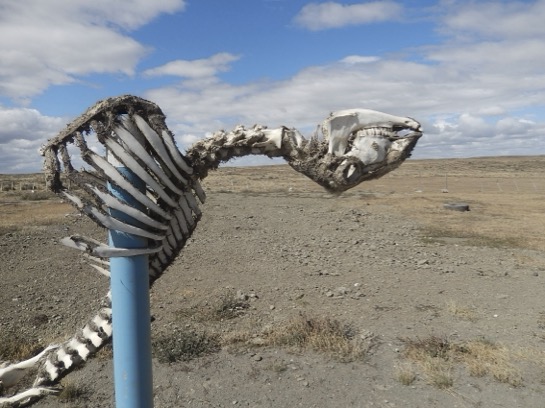
Heading north across the island, I was overjoyed that the main road was partially paved. Such luxury! The scenery was beautiful. Golden, wind-swept, grassy steppes and rolling hills overlooked the ocean. I was alone in this wilderness, unless you count an impaled guanaco (looks a bit like a small deer) on a stop sign!
Approaching the ferry, I joined a long lineup of cars. An active ferry town and the paved Highway 40 beckoned across the water. I waited, and waited, and waited. It appeared that the numerous transport trucks had priority, with only a few small cars squeezed on each crossing. The other problem was strong wind made the usual 20-minute crossing a good hour. I settled in knowing it would be a long wait.
It could have been much worse. At least I had a good book, yummy Oreo cookies, a crunchy sweet apple, water, and the public toilet at the dock was a pleasant kilometre stroll up the highway. Several Chileans approached my driver’s window to ask if I was really travelling alone. My Spanish improved by the hour, practicing with my new friends.
Five hours later, I’m on the ferry. It’s 11:30 PM, cold, dark, windy, and I know I’ll never make it to that lovely hotel in Puerto Natales. Remember this highway is known as “The End Of The World Highway” and I feel like I am, indeed, at the end of the world.
The other problem is, there is a half a tank of gas displayed on the dashboard, which might be enough for the three hours to my hotel, but it might not be, depending on the accuracy of the gas gauge. Also, I’m exhausted, in no condition to drive another three hours through the night, so, I pull into a rest stop planning to sleep on the back seat.
I look longingly at the bottle of Chilean red wine and decide that it would be a really bad idea to indulge. Instead I enjoy a peach yogurt, dried fruits and nuts, a chunk of cheese, and finish the apple. Pulling on every warm item from my bag, I curl up on the back seat, the rocking motion from the strong wind lulling me to sleep.
Unfortunately, I need to turn the car on every hour to warm up, using precious gas. At 5 AM I give up and decide to continue up the highway towards my destination and my toasty warm bed.
That half-tank is constantly on my mind. I’m sure I’ll find a gas station as I’m travelling on the main highway in Patagonia. Just to be cautious, I planned on keeping my speed steady at 80 km/h. I think I read somewhere that you get the best gas mileage keeping your speed around 80.
So, I drove and drove, never going under or over 80, watching the needle slowly approach the quarter mark and then sinking closer towards the dreaded “E.”
The indicator “kissed” empty. I still had another 137 km to my destination. I made a new plan to stop at a ranch and beg for gas. In Patagonia, every farmhouse or ranch is set a good kilometre off the road with impressive gates on the highway.
Practicing my Spanish for “Good morning, I am desesperada por gas,” I stopped at the next fancy wrought-iron gate only to find it locked, keeping out tourists like me. The only solution was to continue and when the tank was dry, flag down someone for help. I tried not to focus on the fact that in three hours I had not seen one single car or truck. I was alone at the end of the world!
I nearly cried with relief as in the distance was a Police road check. I’m pretty sure the car coughed as I rolled to a stop. I smiled at the young officer and explained my situation, pointing to the glowing yellow light on the dash, indicating I was truly empty.
“No gas here,” was the dreaded response. “Solamente 10 km a Natales, Señora.” Pointing down the highway, he added, “It’s all downhill. You’ll be fine, I promise.”
I had the feeling he told this story to stressed-out tourists daily.
OMG! He was right! It was all downhill, and as I rolled, empty, into the gas station, I burst into tears, much to the confusion of the young gas station attendant, wondering why this senior lady was crying over getting gas!
So, that was my adventure of capturing great photos of King Penguins in Patagonia. I should add that my hotel confessed that the number-one complaint from tourists is the scarcity of gas stations in Southern Chile.
The impaled guanaco on the stop sign? I’m convinced it was a frustrated tourist looking for a gas station!
Remember this highway is known as “The End Of The World Highway” and I feel like I am, indeed, at the end of the world.